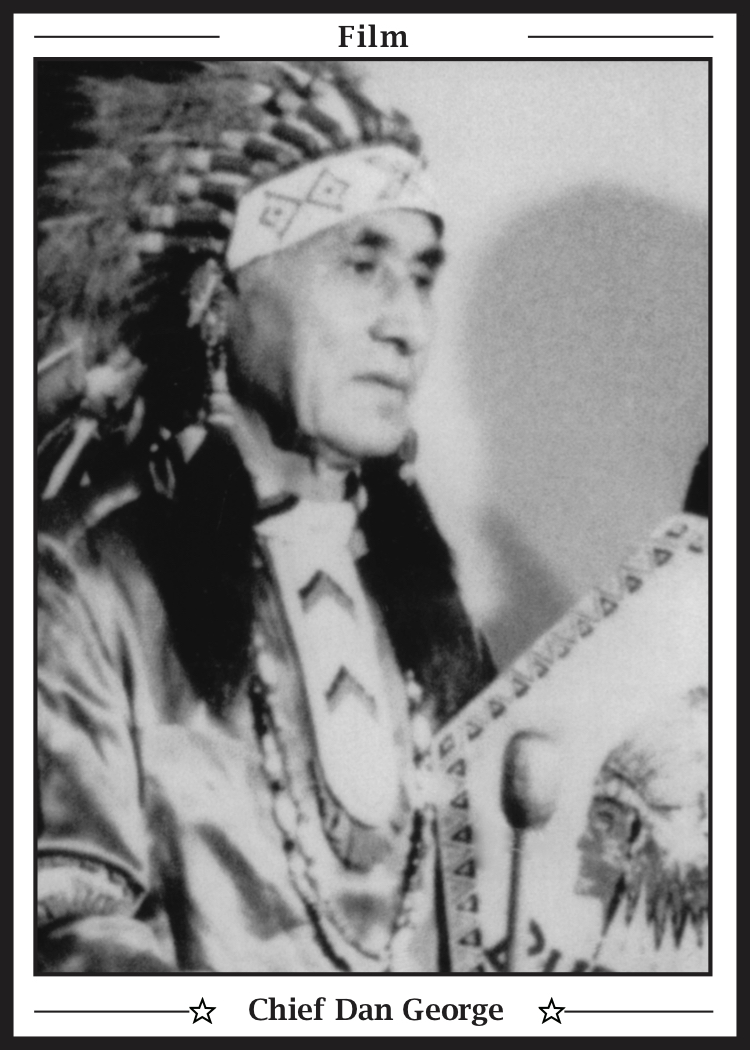


Chief Dan George (1899-1981) is well remembered as a longshoreman, actor, musician, lecturer, poet, activist, environmentalist and Indigenous leader.
Born Geswanouth Slahoot, he was raised in a longhouse on Burrard Indian Reserve #3, now known as the səlilwətaɬ (Tsleil-Waututh) Reserve, which is located near Deep Cove. He received his English name, Dan George, at St. Paul’s residential school, where he was sent when he was five years old.
To most Canadians he is the first well-known Indigenous artist. Before he started acting at the age of 60, George had worked as longshoreman, construction worker, school-bus driver, logger and itinerant musician. He was Chief of the Tsleil-Waututh Nation from 1951 to 1963.
In 1959, he began acting and helped reshape popular culture’s portrayal of Indigenous peoples, challenging the harmful stereotypes and misrepresentations that had long been commonplace.
Chief Dan George performed in many westerns and always played Indigenous characters. Described as a natural, Dan George first brought authenticity to his role of Ol’ Antoine in the 1960s CBC TV series Cariboo Country. With this, his acting career took off and for the remainder of his career, he carefully chose roles that presented a positive and accurate portrayal of Indigenous people.
His career is particularly marked by three performances: as David Joe in the premiere of George Ryga’s The Ecstasy of Rita Joe (1967), for his recitation of his own Lament for Confederation at the centennial celebrations in Vancouver in 1967, and as the deadpan-humourous elder in the movie Little Big Man (1970, opposite Dustin Hoffman). For this, he was nominated for an Academy Award for Best Supporting Actor and became the first Indigenous actor to receive an Academy Award nomination.
During his acting career, Chief Dan George always worked to promote better understanding by non-Indigenous of the First Nations people. His soliloquy, Lament for Confederation, a riveting indictment of the appropriation of native territory by white colonialism, was performed at the City of Vancouver’s celebration of the Canadian centennial in 1967. This speech is credited with escalating native political activism in Canada, as well as touching off widespread pro-Native sentiment among non-Natives.
In addition to acting and dance, he also carved, was a poet and worked to protect the environment. In 1971, George was made an Officer of the Order of Canada. He died in Vancouver in 1981.